Stop asking for permission. Start commanding capital with a bank-ready narrative. You have the potential — I build the capital capacity to prove it.
I spent years in the banker's chair and as a business owner. I know exactly why banks tell you "No."
It usually has nothing to do with your revenue and everything to do with your Financial Architecture.
The Eidon Capital Readiness System bridges that gap.
I operate at the intersection of your internal data and lender requirements to help ensure you are perpetually bank ready and positioned for capital and growth.
Take control of your story before the banks start to write it for you.


My objective is to help business owners clearly see and realize their path to successful financing. Banks and lenders often seem overwhelming and confusing to small and medium sized businesses, but I am able to explain their needs and requirements in a way that simplifies the financing process and makes the requested documents easier to put together. I often say that the way a bank looks at risk is pretty much the same as how a good business owner looks at risk — we just have to translate the bank speak into your language.
To help further illustrate this, check out my content.
Bank declines happen for a number of different reasons — I know them all. The most common decline when you feel your business is strong is because your Financial Architecture fails to translate your operational reality into their language of risk. It's a story gap. Here are a few more of the most common reasons for a no.

A rejection due to inconsistent cash flow narratives or improperly structured collateral follows you, tainting your internal risk profile for future requests. Too many poorly structured requests and lenders don't think you can change, even if you have. Lending is a small world, protect your reputation.

So often business owners try not to come across as 'greedy' or like they are "asking too much" but while a $100,000 here or there seems like a huge amount to you, it often doesn't matter to a lender. Banks have thresholds for types of requests, they would much rather you maximize your request within that threshold and not take all of the money than run out due to not asking for enough in the first place.

Applying when you're desperate and out of money triggers high-risk flags. Lenders focus on historical stability and forward-looking DSCR. They want to know you planned ahead and have some extra capital in case something unexpected happens without coming back to the bank.

Receiving a formal bank refusal — or even when you do secure new capital — you typically will not be able to borrow again for about 12 months. Why 12 months? This allows for the next year's financial statements to come in and enough time for banks to either see if you have been able to deliver on your promised plan or made the changes you had promised. Having the right financial architecture in place can allow for a multi-part borrowing plan or a bigger initial ask to set up for that rapid growth, big goal change.
Avoiding banks and self financing (aka bootstrapping) the business can significantly slow your business growth and reduce your profits.
Being scared of a bank is not a sound approach — let me explain the benefits and how to borrow successfully to maximize your potential.

The path from operational data to lender-ready capital architecture.
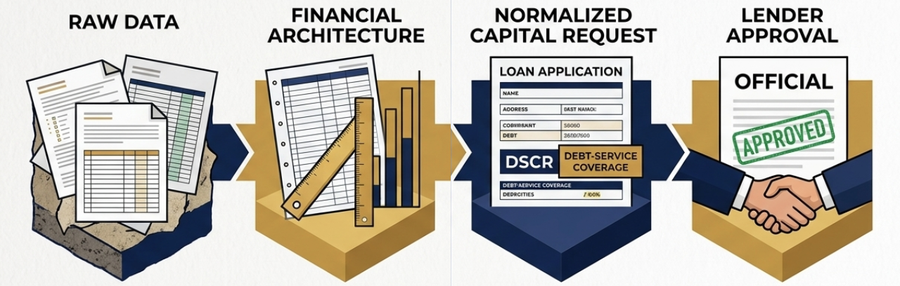

My services assist you every step of the way — and you can continue on your own.

Tier 1: Capital Readiness Assessment
Determines your true baseline capital position, exposes story gaps, and identifies what is out of alignment in terms of your business objectives before you approach a lender, removing ambiguity from your capital requests, and optimizing any equity you may need to invest.

Tier 2: Capital Readiness System
We build your Financial Architecture here together. I will work with you to translate your raw data into a defensible, bank-ready loan package that speaks the lender's language. We will ensure your business is positioned to maximize its borrowing capacity and work to optimize any equity you may need to invest.

Tier 3: Capital Performance Alignment
I provide long-term oversight to successfully navigate extended financing projects and ensure your ongoing operations remain continuously bank-ready.
I'll give you a direct, peer-to-peer view of the key pieces lenders look for and an honest answer on whether working together to complete a full Tier 1, Readiness Assessment is the right fit for you at this time.
Book a Free Readiness CheckIn this complimentary 30 minute session, I bring the plain language directly to your desk. I translate the bank's paperwork into plain, practical terms so you know exactly what the lender is asking of you and your business.
Book a Free Risk and Review SessionThe positive impact of financing.
In short, businesses perform better when they finance.
According to Statistics Canada's Survey on Financing and Growth of Small and Medium Enterprises, high-growth Canadian SMBs (those achieving over 20% annual sales growth) are significantly more likely to utilize structured debt financing — term loans, lines of credit, and commercial mortgages — to scale operations, invest in fixed assets, and enter new markets.
In contrast, over 34% of Canadian SMEs experience zero growth or declining sales, heavily driven by cash flow bottlenecks and under-capitalization. In the eyes of a bank, growth without structured financial architecture isn't expansion — it's risk.
Data from Innovation, Science and Economic Development Canada (ISED) demonstrates that while top-tier small businesses secure up to a 97% approval rate on requested debt capital, nearly 1 in 5 non-seeking businesses decline to apply — either out of perceived high costs or fear of rejection due to weak financial positioning.
BDC's Small Business Health Index tracks that Canadian firms maintaining clear credit visibility and intentional capital deployment maintain cash flow expectations that outpace non-borrowing peers by over 33%.
Data from Statistics Canada, Innovation, Science and Economic Development (ISED), and the Business Development Bank of Canada (BDC).
What's happening with business borrowing across Canada:
| Metric | 2024 | 2025 |
|---|---|---|
| Requested External Financing | 36% | 39% |
| Requested Debt Financing | 9% | 20% |
| Debt Financing Approval Rate | 89% | 97% |
| Required to Pledge Collateral | 66% | 75% |
| Use: Working/Operating Capital | 49% | 45% |
| Use: Debt Consolidation | 17% | 24% |
The overall provincial and national averages obscure the realities of who actually secures funding. A business's success rate in acquiring debt financing varies drastically based on its size and maturity:
Let's position your financing request with the same strategies and resources a medium enterprise has. Book Tier 1 now.
Did you know the Indigenous lending landscape has numerous additional options through their own lending facilities.
| Province/Territory | Micro (1–4) # | Micro % | Small (5–99) # | Small % | Medium (100–499) # | Medium % | Total SMEs | % Requested Financing |
|---|---|---|---|---|---|---|---|---|
| Alberta | 79,703 | 57.30% | 57,479 | 41.30% | 1,941 | 1.40% | 139,123 | 81.60% |
| British Columbia | 99,067 | 57.30% | 71,445 | 41.40% | 2,311 | 1.30% | 172,823 | 82.50% |
| Manitoba | 19,471 | 57.10% | 14,042 | 41.20% | 594 | 1.70% | 34,107 | 81.60% |
| New Brunswick | 11,769 | 57.20% | 8,487 | 41.20% | 325 | 1.60% | 20,581 | 77.00% |
| Newfoundland & Labrador | 7,336 | 57.30% | 5,290 | 41.40% | 172 | 1.30% | 12,798 | 77.00% |
| Nova Scotia | 14,469 | 57.10% | 10,434 | 41.20% | 417 | 1.60% | 25,320 | 77.00% |
| Ontario | 238,300 | 57.20% | 171,854 | 41.20% | 6,640 | 1.60% | 416,794 | 82.40% |
| Prince Edward Island | 3,048 | 57.20% | 2,198 | 41.30% | 79 | 1.50% | 5,325 | 77.00% |
| Quebec | 132,829 | 57.10% | 95,793 | 41.20% | 3,947 | 1.70% | 232,569 | 84.60% |
| Saskatchewan | 19,396 | 57.30% | 13,987 | 41.40% | 448 | 1.30% | 33,831 | 81.60% |
| Territories | 1,622 | 56.50% | 1,169 | 40.70% | 79 | 2.80% | 2,870 | 82.50% |
This data proves that financing isn't just about survival; it's a structural pivot. By formalizing your Financial Architecture and aligning your operational metrics with lender expectations, you bridge the gap between 'micro-business' and the higher-performing business where capital is abundant and approvals are nearly certain.
Eidon helps you move into that category by translating your reality into the high-confidence language lenders require, ensuring you aren't just requesting capital, but commanding it.
Eidon is a Financial Architecture and Capital Capacity Strategy firm. I do not file taxes, nor do I provide daily bookkeeping. I build the bank-facing data systems required to meet commercial underwriting standards.